

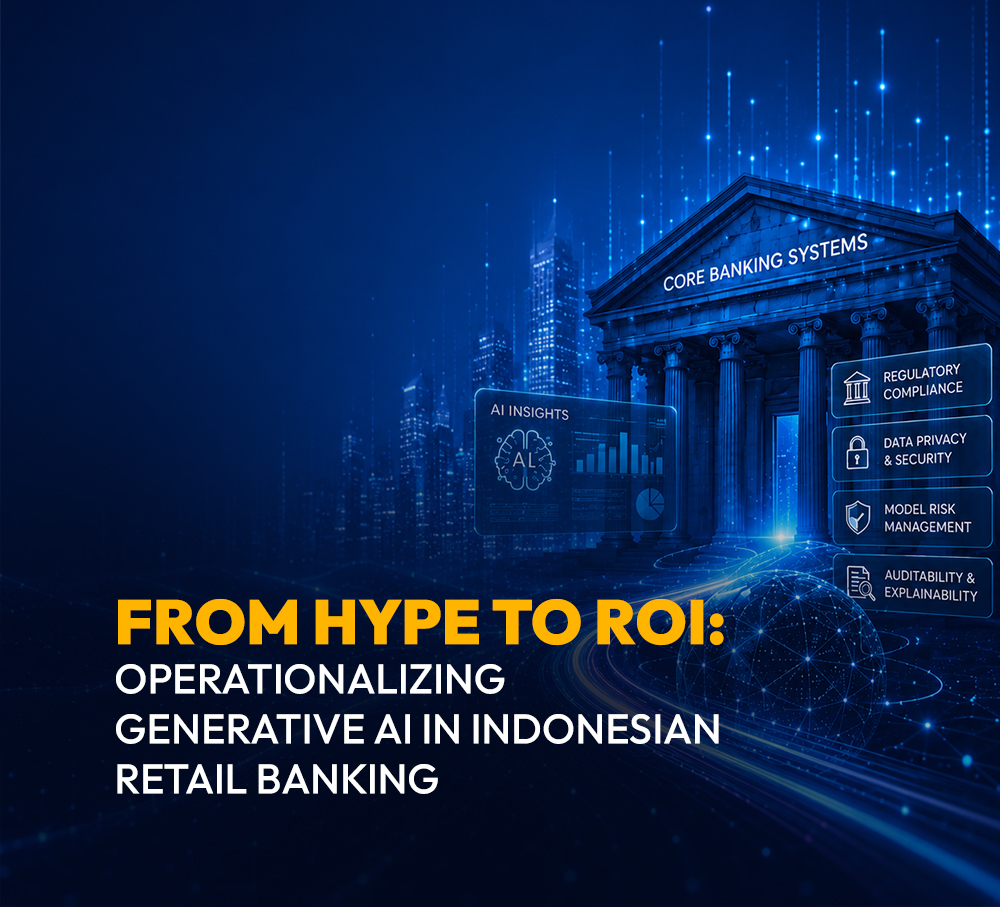
Generative AI has moved beyond experimentation and into boardroom discussions across Indonesia’s banking sector. Yet, enthusiasm alone does not create business value. The challenge facing retail banks today is turning AI investments into measurable outcomes such as lower operating costs, faster customer service, improved risk management, and stronger revenue growth.
As Indonesia’s banking industry accelerates modernization, institutions that operationalize Generative AI with clear governance, scalable infrastructure, and business-focused deployment strategies are beginning to demonstrate tangible returns while advancing broader goals of financial innovation.
Moving Past the Sandbox: The Imperative for Financial Innovation in Indonesia
Indonesia’s banking sector is entering a new phase where Generative AI must progress from pilot environments into enterprise-wide deployment. While innovation sandboxes have provided a controlled environment for experimentation, sustainable value creation requires integration into core banking operations.
The Financial Services Authority (OJK) and Bank Indonesia have established pathways that allow innovative firms and financial institutions to transition from testing to full-scale implementation. This progression is especially important as Indonesia’s financial sector serves a population exceeding 280 million people, with millions still requiring greater access to formal financial services.
The Sandbox-to-Scale Pipeline
Financial institutions typically move through three stages:
- Participation: Controlled testing environments with limited regulatory exposure.
- Registration: Assessment of governance frameworks, risk controls, and consumer safeguards.
- Licensing: Full integration into the regulated financial ecosystem.
For Generative AI initiatives, this journey ensures that customer-facing applications such as virtual assistants, loan advisory systems, and automated documentation tools operate within established compliance standards.
Evolving Regulations
Updated regulatory requirements place significant emphasis on cybersecurity, operational resilience, and data governance. Banks deploying AI-driven solutions must demonstrate robust controls around model monitoring, data management, and customer protection.
Expanding Financial Inclusion
AI-powered solutions can improve access to financial products for MSMEs and underserved communities through enhanced customer onboarding, multilingual support, and intelligent credit assessment. These capabilities strengthen Indonesia’s long-term economic inclusion agenda while creating new growth opportunities for financial institutions.
Structural Overhauls: Deploying Technology Innovation in Financial Services
Indonesia’s banking industry is undergoing extensive transformation driven by artificial intelligence, cloud computing, open finance frameworks, and advanced analytics. According to industry estimates, AI adoption across global banking could contribute hundreds of billions of dollars in annual productivity gains, making implementation a strategic priority rather than a technology experiment.
Key Pillars of Technological Overhaul
API-Based Open Finance
Open finance initiatives enable authorized institutions to securely exchange customer data and services through APIs. This approach expands opportunities for embedded finance, personalized banking experiences, and ecosystem partnerships.
AI and Machine Learning
Banks increasingly deploy AI for fraud detection, risk assessment, customer service automation, and credit decisioning. Generative AI adds another layer by enabling intelligent document generation, knowledge management, and conversational banking.
Blockchain and Distributed Ledger Technologies
Financial institutions are exploring distributed ledger applications to improve transaction transparency, streamline settlements, and support cross-border financial activities.
Digital-Only Banks
The rise of mobile-first banking models reflects changing customer expectations. Digital-native institutions are using AI-powered engagement tools to deliver services at scale while maintaining cost efficiency.
Regulatory Architecture Supporting Innovation
The Indonesian government continues to create frameworks that encourage responsible adoption of emerging technologies.
- Financial Services Omnibus Law: Expands OJK oversight of technology-based financial services.
- Regulatory Sandboxes: Provide structured environments for testing new business models and technologies.
- Consumer Protection Standards: Ensure innovation aligns with financial stability and public trust objectives.
Such developments are accelerating innovation in financial services while maintaining regulatory accountability.
Navigating the IAKD Roadmap: OJK Compliance and Ethical AI Governance
Achieving ROI from Generative AI requires more than deploying models. Sustainable implementation depends on governance structures that support transparency, accountability, and compliance.
Indonesia’s AI-related policy frameworks emphasize trustworthy and explainable AI systems, particularly within financial services where decisions directly affect consumers.
Core OJK Compliance Directives
Model Explainability
Banks must ensure AI-generated outcomes can be understood and justified. Whether evaluating creditworthiness or identifying suspicious transactions, decision-making processes require transparency.
Data Protection and Bias Mitigation
Customer trust depends on secure data handling practices. Institutions must continuously assess training datasets, monitor model behaviour, and address potential biases.
Accountability and Human Oversight
Human supervision remains essential. AI should augment decision-making rather than replace accountability within regulated financial environments.
Consumer Protection
Financial institutions must ensure AI-driven interactions remain fair, transparent, and aligned with established consumer protection obligations.
Regulatory Framework Map
Several frameworks support responsible AI deployment:
- OJK Artificial Intelligence Guidance
- POJK 11/POJK.03/2022 for IT governance
- POJK 10/POJK.05/2022 for digital financial services risk management
- National AI Roadmap 2025–2029
These frameworks create the foundation required for banks to move from AI experimentation towards measurable business outcomes.
Commercializing the Tech Stack: High-Impact Use Cases Driving Scalable Digital Banking
The true measure of Generative AI success lies in commercial execution. Banks must connect technology investments directly to operational efficiency, revenue generation, customer satisfaction, and risk reduction.
High-Impact Use Cases Driving Scalable Banking
AI-Driven Hyper-Personalization
Generative AI enables personalized product recommendations, financial guidance, and customer interactions based on behavioral and transactional insights. Studies indicate that personalized banking experiences can significantly improve customer retention and cross-selling effectiveness.
Cloud-Native Core and Open APIs
Cloud infrastructure provides the scalability required to support AI workloads while reducing infrastructure costs. Combined with API ecosystems, banks can rapidly introduce new services and partnerships.
Real-Time Blockchain Clearing
Modern settlement systems reduce transaction delays and operational costs while enhancing transparency across financial networks.
Privacy-Preserving Analytics
Advanced analytics frameworks allow institutions to generate insights while maintaining compliance with increasingly stringent privacy requirements.
Foundational Tech Stack Architecture
Successful AI-enabled banking models typically consist of five interconnected layers:
- Customer Engagement Layer: Mobile-first experiences and conversational interfaces.
- Integration Layer: APIs connecting internal and external ecosystems.
- Data and Analytics Layer: AI, machine learning, and predictive intelligence.
- Operations Layer: Cloud-native infrastructure supporting scalability.
- Security Layer: Continuous monitoring, fraud detection, and cyber resilience.
This architecture is becoming increasingly critical as the Indonesian digital banking sector continues to expand at a rapid pace, driven by accelerating digital transformation, growing fintech adoption, and evolving customer expectations.
As consumers demand seamless, secure, and always-on banking experiences across digital channels, financial institutions must adopt resilient, scalable, and secure architectures that can support innovation while maintaining regulatory compliance, operational efficiency, and robust cyber resilience.
Join the AI Leadership Discussion at WFIS!
As Generative AI moves beyond experimentation into enterprise-scale implementation, collaboration across the financial ecosystem has never been more important. The World Financial Innovation Series (WFIS) in Indonesia therefore brings together banking leaders, regulators, technology innovators, government officials, and policymakers under one roof to explore strategies for turning AI investments into measurable business value.
Join us on 27–28 October 2026 at Raffles Jakarta to gain insights into emerging AI opportunities, evolving regulatory frameworks, and practical implementation strategies that are shaping the future of Indonesia’s financial services industry.
Register today: https://www.indonesia.worldfis.com/
Frequently Asked Questions (FAQs)
1. Why are Indonesian retail banks investing heavily in Generative AI?
Generative AI helps banks improve operational efficiency, automate customer interactions, strengthen risk management, reduce service costs, and create personalized experiences that contribute directly to measurable business value.
2. How can banks measure ROI from Generative AI initiatives?
Banks typically evaluate ROI through reductions in operating expenses, improved customer satisfaction scores, faster service delivery, increased employee productivity, higher conversion rates, and stronger revenue growth.
3. What role does regulation play in AI adoption within banking?
Regulatory frameworks ensure AI systems remain transparent, secure, accountable, and aligned with consumer protection requirements while maintaining financial stability and public confidence in digital services.
4. Which banking functions benefit most from Generative AI deployment?
Customer service, fraud detection, compliance reporting, knowledge management, credit assessment support, marketing personalization, and operational automation are among the highest-impact banking applications today.
5. Why should financial leaders attend WFIS 2026 – Indonesia?
The event provides access to industry leaders, regulators, policy makers, technology experts, and strategic discussions focused on innovation, AI implementation, financial inclusion, and future banking priorities.