

Indonesia’s MSMEs sit at the centre of economic activity, employment, and local enterprise. Government data shows that more than 64 million MSMEs contribute over 60% of national GDP. They also account for almost 97% of employment. Yet, many viable businesses remain difficult to assess through conventional lending models. Limited credit histories, collateral shortages, and informal records create persistent financing barriers. Therefore, alternative credit scoring is gaining strategic importance. It can assess business behaviour through wider data sources. Meanwhile, regulators are establishing rules for responsible credit assessment. OJK Regulation No. 29/2024 formally governs alternative credit scoring providers.
Why Conventional Credit Assessment Still Excludes Large MSME Segments
Traditional underwriting often depends on collateral, formal accounts, and established credit histories. However, many smaller enterprises lack these records.
Why Conventional Assessment Excludes MSMEs
- Thin Credit Files: Informal businesses may have limited bureau records.
- Collateral Constraints: Small enterprises often lack property suitable for secured lending.
- Documentation Gaps: Informal operators may lack audited statements and structured tax records.
- High Assessment Costs: Manual underwriting can make smaller loans expensive to process.
The financing gap matters because MSMEs represent about 99% of Indonesian business units. Therefore, improving credit assessment can directly support broader economic participation.
The Rise of Alternative Credit Scoring
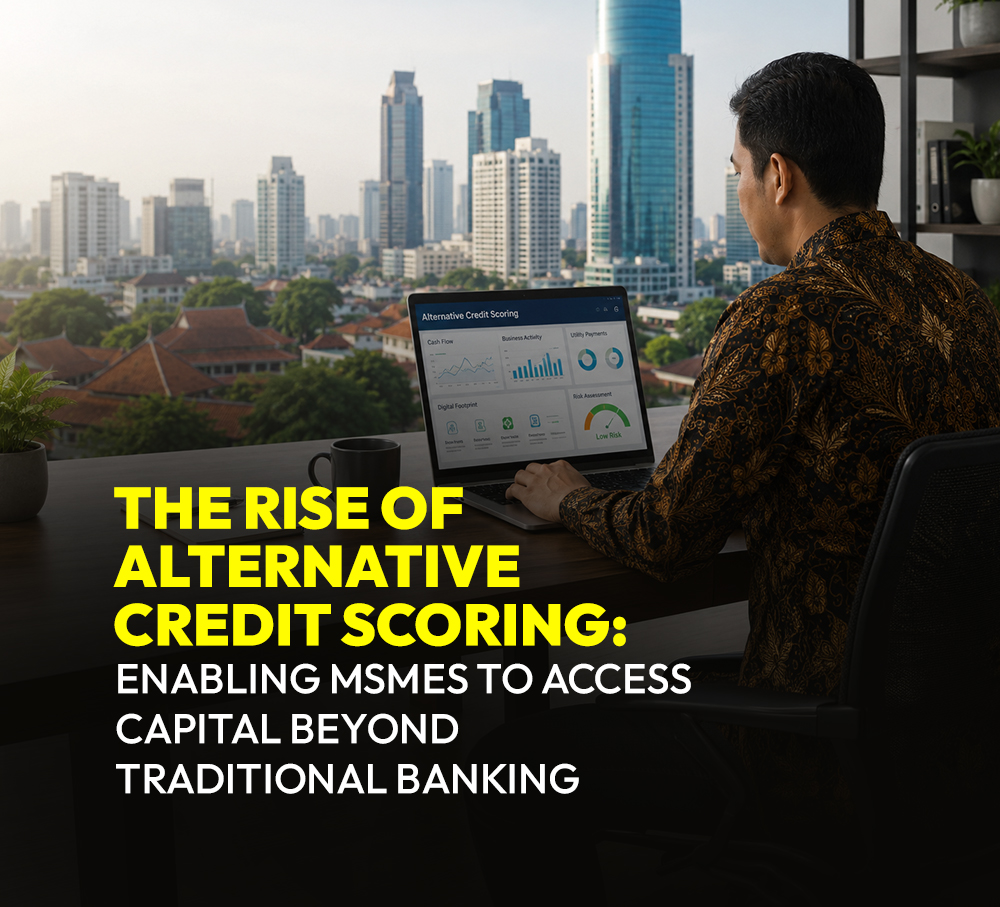
Alternative credit scoring assesses wider financial and behavioural signals. These may include transaction histories, utility payments, e-commerce sales, and supply-chain activity.
Moreover, machine learning can identify patterns across fragmented records. OJK’s 2024 regulation provides a formal framework for this emerging activity.
Building a New Credit Profile from Non-Traditional Data
Innovative scoring can create a broader credit profile for businesses without extensive banking histories. Instead of relying only on previous loans, lenders can examine ongoing business performance.
Non-Traditional Data Sources
- Digital Transactions: QRIS and e-wallet activity can show payment frequency.
- Commercial Behaviour: Sales volumes can indicate demand and operating consistency.
- Supply-Chain Records: Supplier payments can reveal financial discipline.
- Utility Data: Regular payments can provide additional behavioural signals.
- Psychometrics: Structured assessments can add behavioural indicators.
However, data quality remains critical. Incorrect, outdated, or biased inputs can produce unsuitable credit decisions.
Indonesia’s regulatory framework is therefore important for market confidence. OJK Regulation No. 29/2024 covers governance, licensing, supervision, and compliance for alternative credit scoring providers.
The Technical Architecture Behind Alternative Credit Decisioning
A modern scoring system combines multiple data layers before producing a lending recommendation.
The Data Ingestion Layer
E-commerce records can capture sales frequency and order activity. Similarly, QRIS transaction flows can provide visibility into business cash movement.
Supply-chain records can show payment regularity. Utility and telecommunications data can add further behavioural indicators.
Machine Learning and Decisioning Engine
Machine learning models can process thousands of variables simultaneously. Consequently, lenders can identify patterns that traditional scorecards may overlook.
Cash-flow modelling can estimate repayment capacity from transaction behaviour. Meanwhile, behavioural models can identify additional indicators of repayment probability.
Regulatory and Infrastructure Integration
Secure APIs can connect scoring platforms with banks and lending providers. Furthermore, governance controls can support consent, data security, and model monitoring.
This creates an opportunity for a fintech solution Indonesia lenders can integrate without replacing existing credit infrastructure.
Expanding MSME Lending Without Expanding Algorithmic Risk
Alternative scoring can widen access, but greater data access does not automatically mean better lending.
Key Risk Controls
- Data Verification: Lenders should validate alternative data before underwriting.
- Model Explainability: Decision systems should provide understandable risk factors.
- Bias Monitoring: Models require regular testing across different borrower groups.
- Human Oversight: Complex cases should retain qualified credit review.
- Consent Management: Borrowers should understand how their data supports decisions.
Therefore, hybrid underwriting can balance automation with professional judgment. This approach can support responsible growth while reducing dependence on opaque automated decisions.
For banks and fintechs, the opportunity extends beyond lending volume. Better scoring can improve portfolio segmentation, pricing, early-warning systems, and customer acquisition.
From Jakarta-Centric Lending to Province-Level Financial Inclusion
Alternative scoring can help financial institutions reach businesses outside major commercial centres. Regional MSMEs often generate meaningful transaction activity without maintaining conventional financial records.
For example, digital sales and payment data can create useful credit signals across provinces. Consequently, lenders can assess smaller businesses using operational evidence rather than location alone.
This shift can strengthen financial inclusion across Indonesia. It can also create demand for scalable fintech Indonesia infrastructure that connects lenders, data providers, and MSMEs.
Moreover, broader participation can support regional entrepreneurship and supply-chain development. The challenge will be maintaining consistent data standards and responsible lending practices.
Join the Conversation on the Next Generation of MSME Finance at WFIS Indonesia
WFIS Indonesia 2026 will bring financial leaders together on 27–28 October 2026 at Raffles Jakarta. The event will examine financial inclusion, technology, lending, emerging financial models and a lot more. Delegates will have the golden opportunity to engage with senior executives, government officials, policymakers, and industry experts. On the other hand, sponsors can build strategic relationships with influential decision-makers. Join the alternative finance conference to discuss how responsible innovation can expand MSME finance across Indonesia.
Frequently Asked Questions (FAQs)
What is alternative credit scoring?
Alternative credit scoring evaluates non-traditional data, including transactions, payments, and business behaviour, to assess borrowers without relying solely on conventional credit records.
Why does alternative scoring matter for Indonesian MSMEs?
It can help lenders assess businesses lacking collateral or established credit histories. Consequently, viable enterprises may gain access to more suitable financing.
What data can alternative scoring systems use?
Systems may analyse QRIS activity, e-commerce transactions, utility payments, supplier records, and other consented information to understand financial behaviour and repayment capacity.
How is Indonesia regulating alternative credit scoring?
OJK Regulation No. 29/2024 establishes requirements covering licensing, governance, supervision, operations, and compliance for alternative credit scoring providers.
Why should financial leaders attend WFIS Indonesia?
WFIS Indonesia connects senior financial executives, policymakers, technology leaders, and industry experts to discuss practical opportunities shaping Indonesia’s financial inclusion priorities.