

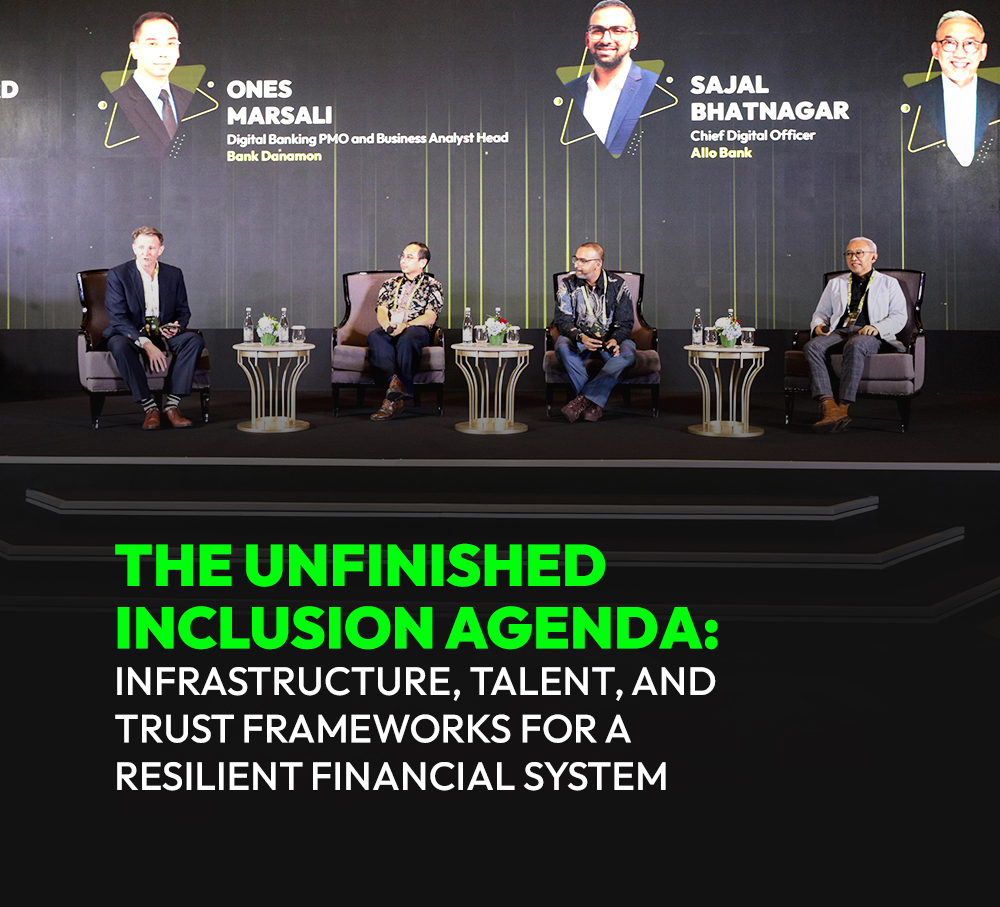
Indonesia has made notable progress in expanding access to financial services, yet millions of citizens and businesses remain outside the formal financial system. While mobile connectivity, fintech adoption, and policy reforms have accelerated access, inclusion today depends on more than account ownership alone. Building a stronger financial system requires investments in infrastructure, workforce capabilities, and trust mechanisms that support sustainable participation.
As Indonesia advances its national development goals, these foundations will determine how effectively economic opportunities reach every segment of society.
Reaching the Last Mile: Navigating the Realities of a Massive Unbanked Population
Despite rapid progress in digital finance, Indonesia remains home to one of the world’s largest underbanked populations. This presents a significant opportunity for banks, fintech firms, regulators, and development institutions to expand financial inclusion, broaden access to essential financial services, and drive more inclusive economic growth through digital innovation.
Geographic and Structural Hurdles
The ‘last mile’ refers to reaching rural and remote areas outside the economic hub of Java. Traditional bank branches and ATMs remain concentrated in urban centres. As a result, nearly one-third of unbanked Indonesians identify geographic distance as a major barrier to accessing formal financial services.
Indonesia’s unique archipelagic structure, comprising more than 17,000 islands, further increases the complexity and cost of service delivery. Limited connectivity infrastructure, lower digital literacy levels, and fragmented logistics networks continue to affect financial accessibility in many regions.
The Financial Inclusion Gap
- Account Ownership: Despite the rise of digital wallets and mobile payments, historical data from international financial inclusion studies indicates that tens of millions of Indonesians still lack access to formal banking services.
- The “Invisible” Wealth: Analysts estimate that hundreds of billions of dollars in potential savings remain outside regulated financial institutions, limiting capital formation and reducing opportunities for wealth generation.
- Credit Constraints: Formal borrowing and savings participation remain relatively low among micro-entrepreneurs and informal workers, making it difficult to establish credit histories and secure business financing.
Digital Solutions Bridging the Gap
To reach underserved communities, Indonesia continues to deploy targeted digital interventions and public-private initiatives.
- Digital Wallets: Platforms such as DANA are integrating micro-savings, micro-insurance, and government assistance programs into mobile applications, helping users engage with formal financial services.
- National Payments Infrastructure: Bank Indonesia’s BI-FAST network and the rapid adoption of QRIS payment standards are accelerating cashless transactions and supporting greater inclusion across merchants, consumers, and small businesses.
These initiatives demonstrate how technology-led financial inclusion solutions can connect underserved populations to formal economic opportunities while reducing operational costs for service providers.
Engineering Sustainable Accessibility: Architecting Scale via Financial Inclusion Solutions
Engineering sustainable accessibility in Indonesia requires scalable and interoperable systems capable of serving more than 220 million digitally connected citizens. Long-term success depends on balancing innovation with practical infrastructure realities.
Key Architectural Pillars
- Digital Public Infrastructure (DPI): Interoperable identity systems, consent-based data sharing frameworks, and integrated payment rails enable secure and affordable access to financial services at scale.
- Alternative Credit Scoring (ICS): Artificial intelligence and data analytics can evaluate non-traditional indicators such as transaction patterns, utility payments, and mobile usage, helping lenders assess previously invisible borrowers.
- Cloud-Native Core Banking Platforms: Modern cloud architectures and microservices support operational scalability while reducing dependency on legacy systems.
- User-Centric Accessibility: Financial services must remain simple, affordable, multilingual, and tailored to varying levels of digital literacy throughout the archipelago.
The next generation of financial inclusion solutions will depend on strong collaboration among regulators, financial institutions, fintech providers, and telecommunications operators.
Cultivating Consumer Trust: Building Reliable Financial Innovation and Technology Protocols
Trust remains one of the most important drivers of adoption across Indonesia’s financial ecosystem. Consumers increasingly expect transparency, security, and accountability from providers offering digital financial services.
Core Pillars of Consumer Trust in Indonesia
- Regulatory Sandbox and Licensing: Indonesia’s Financial Services Authority (OJK) continues to strengthen regulatory oversight through licensing requirements and sandbox programs that evaluate emerging technologies before large-scale deployment.
- Data Privacy and Cybersecurity: Comprehensive data protection requirements, stronger KYC procedures, encryption standards, and fraud monitoring systems help safeguard consumer information and financial transactions.
- Islamic Financial Technology (Syariah Fintech): Ethical financing structures, transparent fee mechanisms, and Sharia-compliant products continue to build confidence among Indonesia’s predominantly Muslim population.
- Financial Literacy and Education: Public awareness campaigns play an essential role in helping consumers identify legitimate providers and avoid fraudulent digital lending operations.
As adoption grows, confidence in financial innovation and technology will increasingly depend on transparent governance, cybersecurity readiness, and consumer protection frameworks.
The Ecosystem Talent Gap: Cultivating Local Digital Leadership and Engineering Cadres
Technology alone cannot close inclusion gaps without the talent needed to design, manage, and regulate increasingly sophisticated financial ecosystems. Indonesia faces growing demand for cybersecurity specialists, cloud engineers, AI practitioners, data scientists, compliance experts, and digital banking professionals.
According to industry estimates, Southeast Asia’s digital economy may require millions of additional skilled workers over the coming decade to support projected growth.
Building the Workforce for Inclusive Finance
- Industry-Academia Collaboration: Universities, vocational institutions, and financial organizations must work together to align curricula with emerging industry requirements.
- Upskilling Existing Professionals: Continuous learning programs can help financial institutions modernize operations while preparing employees for technology-driven roles.
- Leadership Development: Future-ready organizations require executives capable of balancing innovation, risk management, regulation, and customer expectations.
- Public Sector Capability Building: Regulators and policymakers also need access to specialised expertise to oversee increasingly complex financial ecosystems.
Addressing these workforce challenges will strengthen institutional capacity and ensure that innovation remains inclusive, secure, and sustainable.
Explore the Future of Financial Inclusion with WFIS!
Indonesia’s financial inclusion agenda requires coordinated action across infrastructure, talent, regulation, and digital trust. Achieving meaningful progress will depend on collaboration between financial institutions, regulators, technology providers, and policymakers.
The World Financial Innovation Series (WFIS) in Indonesia provides a premier platform for delegates, sponsors, C-suite executives, government officials, policymakers, and industry leaders to exchange insights, explore emerging technologies, and develop practical strategies for the future of financial services.
Join WFIS on 27–28 October 2026 at Raffles Jakarta and connect with the leaders driving financial innovation and inclusion across Indonesia.
Learn more and secure your participation at https://www.indonesia.worldfis.com/.
Frequently Asked Questions (FAQs)
1. Why is financial inclusion still a challenge in Indonesia?
Despite high mobile penetration and growing fintech adoption, Indonesia continues to face barriers to financial inclusion, including geographic fragmentation, uneven digital infrastructure, limited financial literacy, and unequal access to formal banking services across diverse communities.
2. How can digital financial services help underserved communities?
Digital platforms reduce operational costs, expand service reach, enable remote onboarding, and provide accessible savings, payments, insurance, and credit products through mobile devices.
3. What role does trust play in financial inclusion?
Trust encourages consumers to adopt formal financial services. Strong cybersecurity, transparent policies, regulatory oversight, and data protection measures help build long-term confidence.
4. Why is talent development important for the financial sector?
Financial institutions require skilled professionals in cybersecurity, AI, data analytics, cloud computing, and compliance to support innovation and maintain secure operations.
5. What can attendees gain from WFIS 2026 – Indonesia?
Attendees can access expert insights, policy discussions, networking opportunities, technology showcases, and practical strategies for advancing inclusion and financial sector growth.