

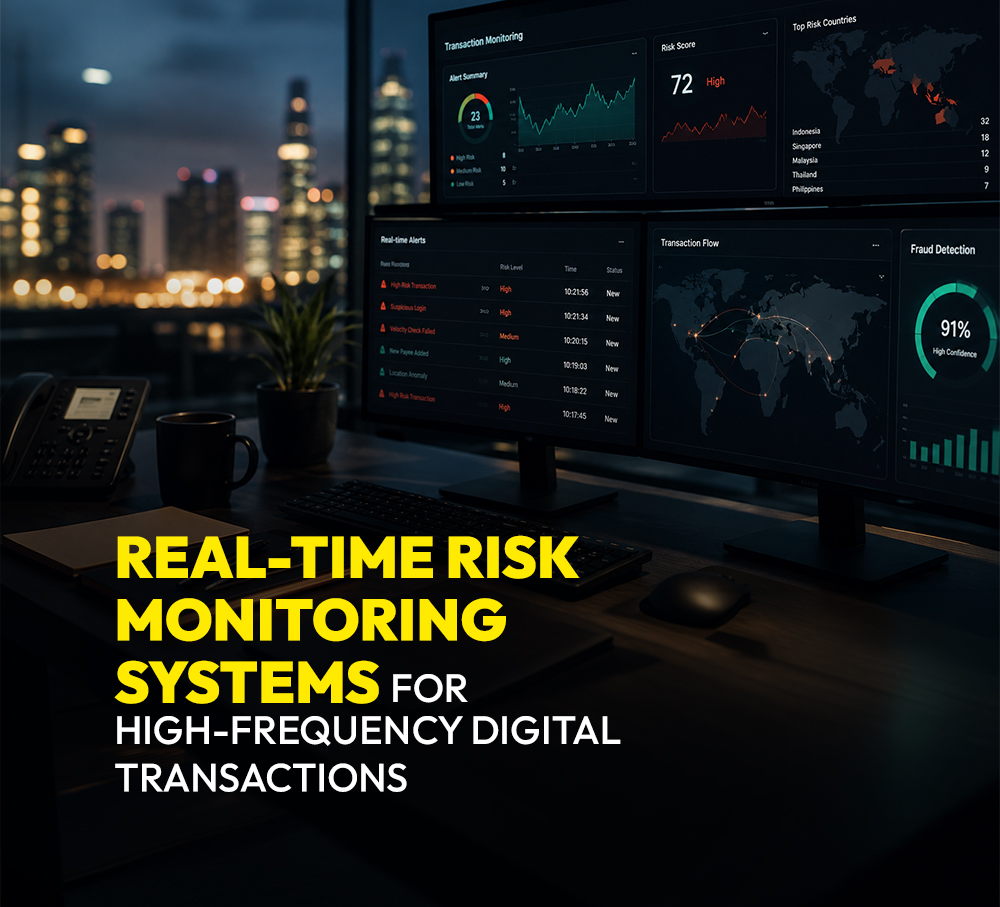
Indonesia’s financial ecosystem is processing unprecedented volumes of digital payments, account transfers, QR transactions, and embedded financial services. With Bank Indonesia reporting billions of digital banking transactions annually and electronic payment values continuing to rise, financial institutions face increasing pressure to identify risks as they emerge rather than after they occur. Traditional monitoring methods built around periodic reporting can no longer provide the visibility required to manage modern transaction flows. Real-time risk monitoring systems have therefore become a strategic necessity, helping institutions detect fraud, strengthen compliance, manage liquidity exposure, and maintain customer confidence while supporting continued growth across Indonesia’s expanding digital financial infrastructure.
Why Real-Time Risk Monitoring Has Become Essential
Real-time risk monitoring is essential for Indonesia’s financial sector due to explosive growth in digital transactions, stringent mandates from the Financial Services Authority (OJK), and elevated cyber and liquidity risks.
The transition from traditional, batch-processed reporting to active monitoring is driven by several key factors in the local market:
Regulatory Compliance (OJK Mandates)
ILAAP Compliance: The OJK’s mandate (SEOJK 26/2025) on the Internal Liquidity Adequacy Assessment Process requires banks to perform regular stress-testing and intraday liquidity monitoring.
AML/CFT Supervision: As a member of the Financial Action Task Force (FATF), Indonesia has strengthened enforcement against money laundering, requiring greater coordination between regulators and financial institutions through near real-time transaction reporting.
Surge in Digital Fraud and Cybersecurity
Digital Acceleration: The rapid expansion of APIs, QRIS, open banking initiatives, and digital banking indonesia platforms has created new opportunities for innovation while expanding potential attack surfaces for cybercriminals.
Proactive Defense: Real-time monitoring supported by artificial intelligence enables institutions to identify suspicious behavior patterns instantly, helping prevent fraud before it affects customers or disrupts payment ecosystems.
Heightened Liquidity and Credit Risks
FX Volatility: Global market uncertainty and domestic economic factors can create sudden liquidity pressures, requiring institutions to monitor exposures continuously rather than periodically.
MSME Exposure: Early identification of deteriorating credit quality among micro, small, and medium enterprises allows lenders to take corrective action before risks escalate into significant portfolio losses.
Technologies Powering Real-Time Risk Monitoring
Indonesia’s financial and banking sectors rely on a modern technology stack, primarily Artificial Intelligence (AI), cloud infrastructure, Big Data analytics, and Regulatory Technology (RegTech), to enable real-time risk monitoring, dynamic credit scoring, and immediate fraud detection.
Core Technologies
- AI and Machine Learning: Advanced models analyze thousands of data points in real time to identify unusual transaction patterns, predict risk events, and strengthen fraud detection capabilities. Many institutions are increasingly integrating these capabilities into broader fintech technology initiatives to improve operational decision-making.
- Cloud Computing: Cloud-based infrastructure provides the processing capacity required to handle large transaction volumes across geographically distributed banking networks and digital service providers.
- Big Data Analytics: Financial institutions can move beyond retrospective reporting by using live dashboards that provide continuous visibility into liquidity positions, credit exposures, and operational performance.
- RegTech and API Gateways: Automated KYC, AML screening, and transaction monitoring processes enable institutions to meet compliance obligations efficiently while maintaining secure and uninterrupted data exchange.
Together, these technologies create an integrated monitoring environment capable of responding to risks within seconds rather than hours or days.
Managing Fraud, Compliance, and Operational Risks
Managing fraud, compliance, and operational risks in Indonesia’s finance and banking sector requires strict adherence to Financial Services Authority (OJK) mandates. Key requirements involve implementing enterprise-wide anti-fraud strategies, strengthening cybersecurity frameworks, and fulfilling anti-money laundering reporting obligations.
Key Regulatory Frameworks and Compliance
- OJK Anti-Fraud Regulation (Reg 12/2024): This framework requires financial institutions to establish comprehensive fraud prevention, detection, investigation, and response mechanisms.
- IT Governance and Cyber Resilience (POJK No. 11/2022): Institutions must maintain cybersecurity frameworks, perform continuous monitoring, and conduct periodic evaluations to address technology-related risks.
- AML/CFT Obligations: Financial institutions are required to maintain robust KYC and Customer Due Diligence procedures while reporting suspicious transactions within prescribed timelines.
Operational and Fraud Risk Management Strategies
- Whistleblowing Systems and Corporate Culture: Effective governance frameworks encourage transparent reporting of misconduct and strengthen internal controls.
- Advanced Identity and Transaction Monitoring: Biometric authentication, document verification, and behavioral analytics provide additional layers of protection against account takeover and identity fraud.
- Independent Audits: Regular assessments help validate the effectiveness of fraud prevention frameworks and ensure continued compliance with evolving regulatory expectations.
As transaction volumes continue to increase, financial institutions that combine governance frameworks with real-time monitoring capabilities are better positioned to protect customers and maintain operational integrity.
Enhancing Customer Experience Through Intelligent Monitoring
Intelligent monitoring uses AI and machine learning to analyze customer interactions and transaction behavior in real time. In Indonesia’s rapidly digitizing banking environment, this enables institutions to improve service quality while strengthening risk management.
Proactive Customer Support and Hyper-Personalization
Real-Time Contextual Assistance: AI-powered virtual assistants can identify customer intent and provide immediate guidance during transactions, reducing service delays and improving user satisfaction.
Hyper-Personalized Offers: Real-time behavioral insights allow institutions to deliver relevant product recommendations based on customer needs and financial activity.
Streamlined Issue Resolution
Frictionless Onboarding: Monitoring customer journeys helps identify bottlenecks during account opening and electronic KYC processes, reducing abandonment rates.
Predictive Outage Management: Institutions can detect system performance issues before they affect customers, improving service availability across payment and banking channels.
Fraud Prevention and Trust Building
Zero-Trust Security: Continuous monitoring evaluates every transaction against risk parameters, strengthening security across customer touchpoints.
Minimizing False Positives: More accurate risk models reduce unnecessary transaction declines, creating a smoother customer experience while maintaining strong protection standards.
As customer expectations continue to rise, intelligent monitoring is becoming a key differentiator for institutions seeking to balance convenience, security, and compliance. These discussions are increasingly taking center stage at every major financial technology summit focused on banking modernization and risk management.
Get an Expert Overview on Real-Time Risk Monitoring Systems at WFIS Indonesia
WFIS Indonesia, taking place on 27–28 October 2026 at Raffles Jakarta, brings together C-suite executives, government officials, policymakers, regulators, industry leaders and solution providers driving the future of finance. As a premier banking innovation summit, the event will feature strategic discussions on risk monitoring, fraud prevention, AI adoption, compliance, and financial inclusion. Join the conversations shaping Indonesia’s financial future and connect with decision-makers leading transformation across the banking and financial services sector.
Frequently Asked Questions (FAQs)
Why are real-time risk monitoring systems important for financial institutions?
Real-time risk monitoring systems help financial institutions identify fraud, liquidity issues, compliance breaches, and operational disruptions instantly, enabling faster responses and reducing potential financial and reputational damage.
How does artificial intelligence improve real-time risk monitoring?
Artificial intelligence analyzes large transaction volumes continuously, detects unusual patterns, predicts emerging risks, and improves fraud detection accuracy while minimizing false alerts that affect customer experiences.
What role does regulatory compliance play in risk monitoring?
Regulatory compliance requires institutions to monitor transactions, manage liquidity, detect suspicious activities, and maintain reporting standards, making real-time monitoring essential for meeting evolving supervisory requirements.
How does real-time monitoring enhance customer experience?
Real-time monitoring reduces transaction delays, prevents fraudulent activities, improves service reliability, supports personalized financial recommendations, and helps ensure secure and uninterrupted banking experiences for customers.
What technologies support real-time risk monitoring systems?
Modern risk monitoring systems combine artificial intelligence, machine learning, cloud computing, big data analytics, and RegTech solutions to provide continuous visibility into operational, financial, and compliance risks.